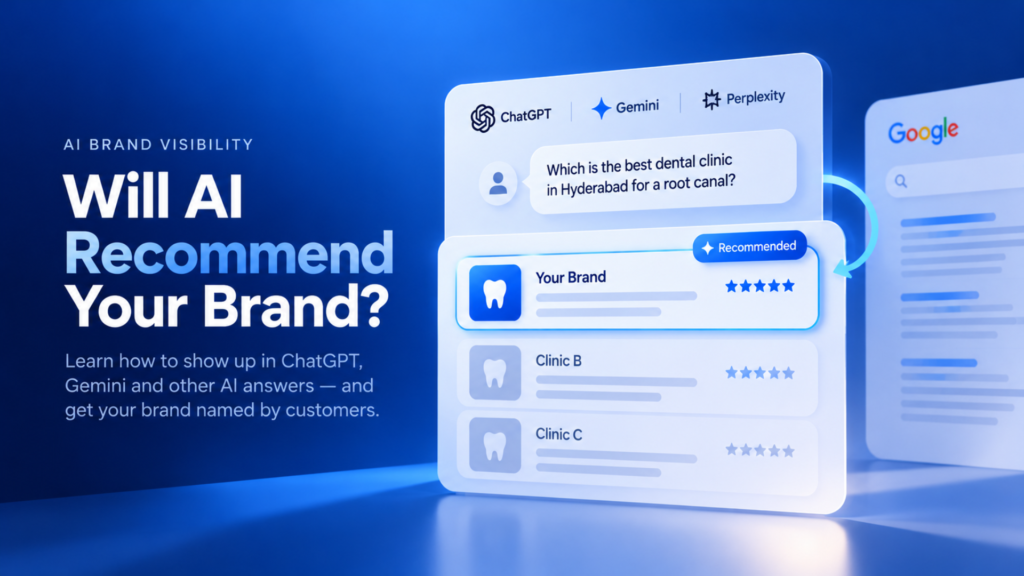
It’s 11 p.m. Someone in Hyderabad is lying awake with a toothache.
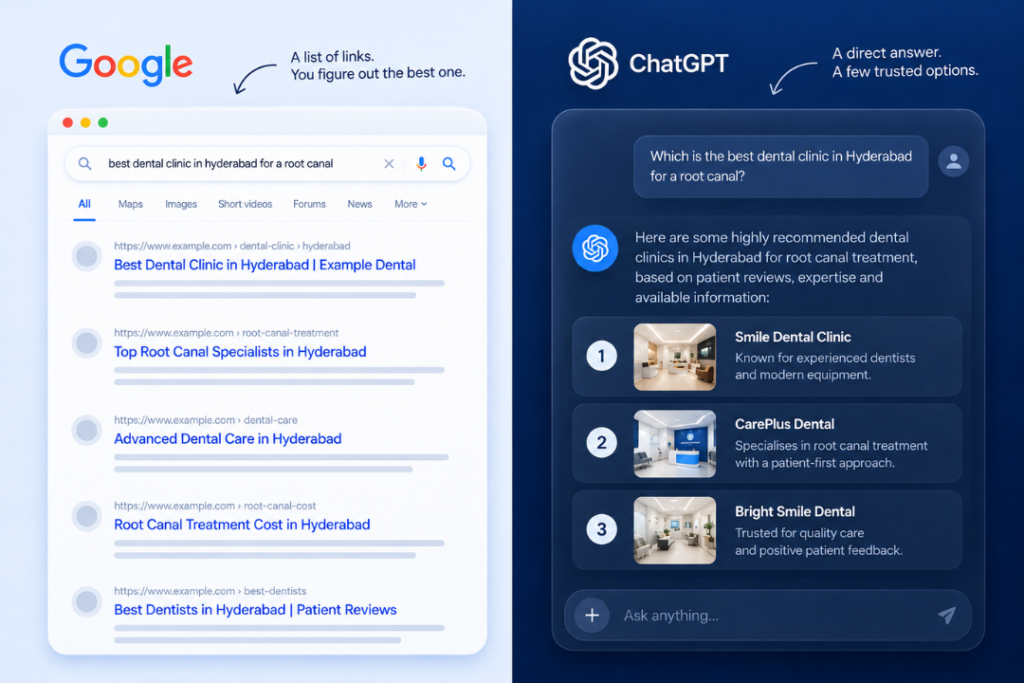
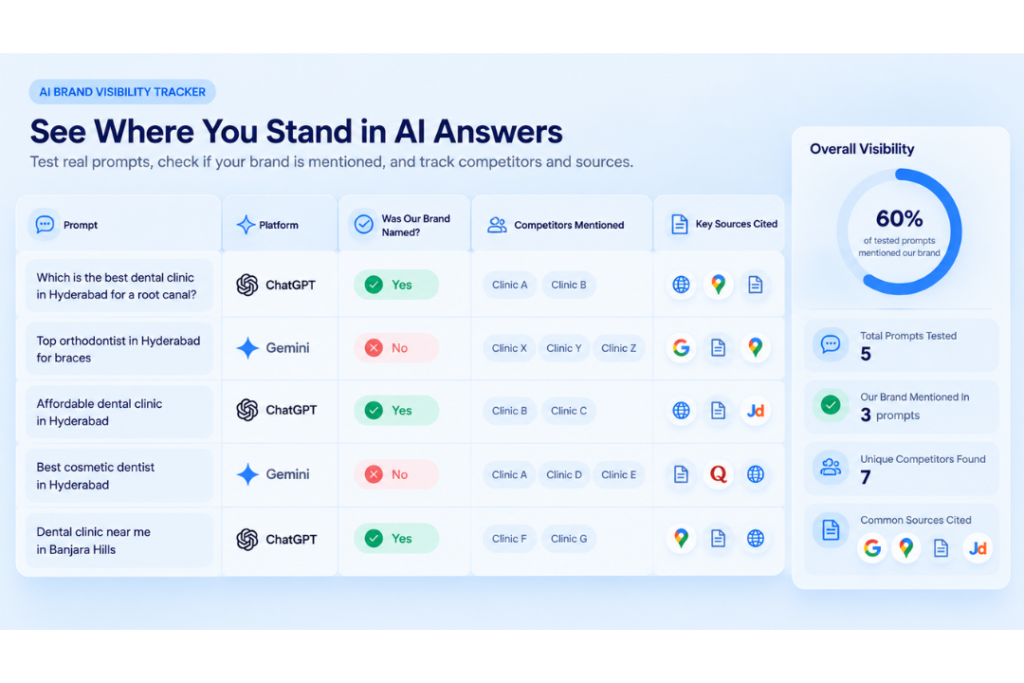
They open ChatGPT and type: “Which is the best dental clinic in Hyderabad for a root canal?”
Three clinics come up, each with a short reason why.
Yours isn’t one of them.
There was no page one to fight for, just an answer that didn’t include your clinic.
That’s AI brand visibility in action. It’s not just about whether someone can find your clinic. It’s about whether your clinic makes the shortlist when they ask for a recommendation.
The good news? You don’t have to start from scratch. A lot of this comes down to the same things that have always mattered: being clear about what you do and giving people reasons to trust your brand.
Table of Contents
What Is AI Brand Visibility, and Why Does It Matter?
AI brand visibility simply means how often tools like ChatGPT and Gemini mention your business when someone asks a question you should be the answer to. It matters because customers used to start with Google. Many now start by asking an AI assistant, and the shortlist forms before anyone opens your website.
A couple of numbers show where this is heading:
- India is a huge ChatGPT market. OpenAI CEO Sam Altman said in February 2026 that India had 100 million weekly active ChatGPT users, making it the platform’s second-largest market after the US.
- Analysts expected the search to shift. In 2024, Gartner predicted that traditional search engine volume would fall 25% by 2026 as AI chatbots and virtual agents take over queries.
Nobody can say exactly how these numbers will play out, but the direction is clear: more people are asking AI first.
For most businesses, and especially B2B ones, the stakes are higher. Your customers research quietly, long before they call or fill in a form. If the assistant doesn’t know you, you’re not on the list they call from.
This isn’t something to keep an eye on for later. If potential customers are turning to AI for recommendations, you want your business to be part of that conversation.
How Do ChatGPT and Gemini Decide Which Brands to Mention?
ChatGPT and Gemini mention brands they can clearly identify, find repeated across trustworthy sources, and verify with specific evidence. They draw on what they learned in training and, increasingly, on live web sources. In short: a clear identity, consistent mentions, and proof that someone other than you will back you up.
Think of it as two layers.
Layer one is memory. What the model absorbed about your category while it was trained.
Layer two is lookup. Search features pull live pages and stitch them into an answer. Google says AI Overviews and AI Mode may use “query fan-out”, running several related searches across subtopics to build one response. Gemini lives in Google’s world, so your Google footprint (Business Profile, indexed pages, reviews) carries extra weight.
One question can quietly turn into several searches. A patient asking about root canals might trigger checks on costs, reviews, doctors’ qualifications and clinics nearby. Your business has to show up in all of those, not just the obvious one.
Here’s the part many people leave out. Google’s own documentation says there are no additional requirements, and no special optimisations, to appear in AI Overviews or AI Mode. What does still apply, though, is solid SEO fundamentals.
So, skip the secret-file hype. You don’t need to overcomplicate things. Just make sure people can understand what you do, find the information they need and trust what they see.
Here’s how to do that:
Step 1: Say Who You Are, the Same Way, Everywhere
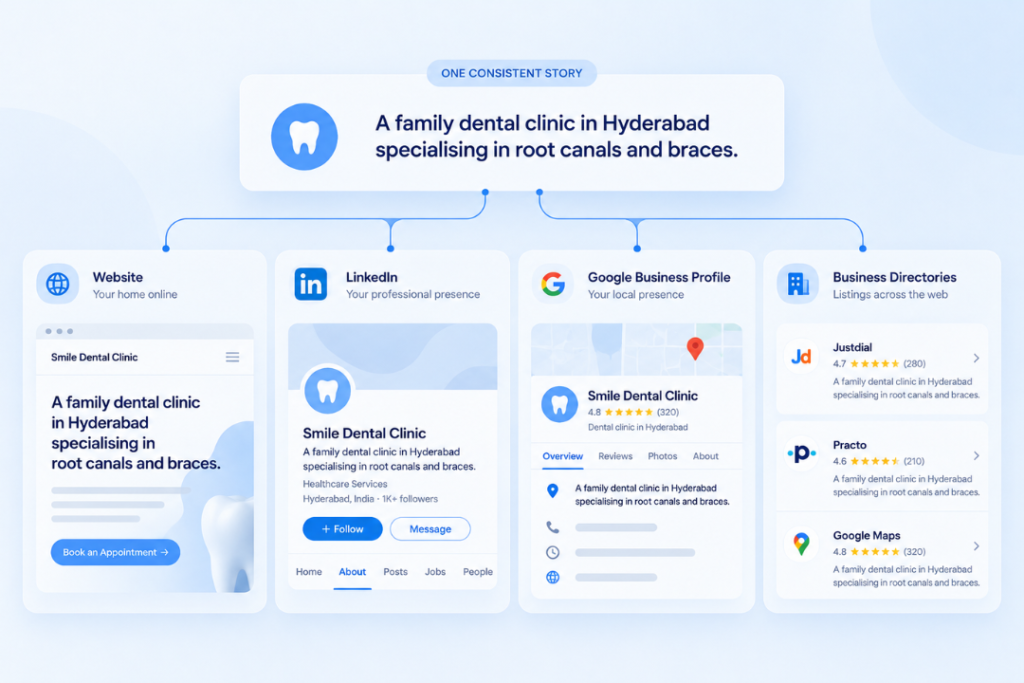
Open your website, your LinkedIn page, your Google Business Profile and your directory listings. Read the first line of each.
Do they describe the same business?
If one place says “family dental clinic,” another says “dental care centre” and a third says “smile studio,” a person shrugs. An AI tool hedges. And when it hedges, it names someone else.
Fix it by picking one sentence that says what you do, who you do it for and where, like “a family dental clinic in Hyderabad specialising in root canals and braces.” And then use it everywhere:
- Keep your name identical. Not “Smile Dental” on Google and “Smile Dental Care” on Instagram.
- Use one description. Say what you do in the same words on your website, LinkedIn and every listing.
- Give every service its own page. If you offer braces, root canals and implants, each deserves its own page, and so does each location.
- Fill in your profiles properly. Your Google Business Profile should be complete, up to date and match your website.
- Keep your schema markup honest. This is the behind-the-scenes code that helps search tools understand your page, and it should only describe what’s actually on it.
It’s basic, but it’s the foundation. It’s also where our SEO and branding work usually starts, because AI brand visibility is built on it.
Step 2: Publish Things Worth Quoting
Content that makes big claims without backing them up doesn’t give readers much to work with. Specific examples, reliable sources and useful details make your content more credible and easier to reference.
Researchers from Princeton, IIT Delhi and others tested ways to lift visibility inside AI-generated answers. Adding citations, quotations from relevant sources and statistics boosted visibility by up to 40% in their experiments. A benchmark isn’t your market, but the instinct holds: be specific.
In practice, that looks like:
- Answer real buyer questions. “How much does a root canal cost?” or “How do manufacturers generate B2B leads on LinkedIn?” Write the answer first, then the nuance.
- Show your numbers. Outcomes, timelines and process details from your own work. Not “we boost growth.” How much, and in how long.
- Don’t try to cover everything at once. Focus on the topics your business actually knows well and build from there. Over time, that gives people a clearer idea of what you’re good at.
- Name your sources. Link to the research you rely on. Credible writing cites credible people.
(Yes, a growth partner telling you to publish more content. We see the irony but we’re also the ones who’ll help you do it properly.)
This is the heart of good content generation, too. What AI can trust and what humans enjoy turn out to be the same thing: clear, specific, and useful.
Step 3: Get Talked About Beyond Your Own Website
Your own website can tell people a lot about your business, but it shouldn’t be the only place they hear about you.
AI systems look for corroboration: other credible sources saying similar things about you. That means:
- Reviews with real detail, not just star ratings
- Client testimonials with names, roles and specifics
- Industry directories and association listings
- Guest articles, podcasts and event mentions in your sector
- A consistent, active LinkedIn presence from your founders and team
Where you’re mentioned matters just as much as how often. Ten mentions where your buyers actually read beat a hundred where nobody does. Depending on your industry, the best places differ: a dental clinic might lean on local health directories and review sites, while a manufacturer is better off with industry bodies and trade publications.
Step 4: Make Your Site Easy to Read, for People and Machines
If visitors struggle to find basic information on your website, they may leave before they get to what makes your business worth considering. What to do?
- Answer first. Lead each section with the direct answer, then explain.
- Use clear headings. Question-style H2s that mirror how buyers actually ask.
- Add an FAQ. Short, direct answers to real questions.
- Keep it fast and crawlable. Check your settings aren’t blocking the crawlers behind search features.
That’s as much a website development job as a content one.
Step 5: Test It Like You Mean It
Once you’ve made these changes, check whether they’re making a difference.
Once a month, ask ChatGPT, Gemini and Perplexity the questions your customers ask. Note whether you’re named, who else is, and which sources get cited. Use the same prompts each time.
And keep a close eye on Search Console. Google says traffic from AI features is counted in your overall search performance there. Tracking AI brand visibility isn’t about perfect measurement. It’s about honest measurement, which beats guessing.
Be the Name in the Answer
Back to that 11 p.m. patient.
They asked a question and got three clinic recommendations. Those clinics had information people could find, check and use to make a decision.
You can’t control which businesses an AI tool recommends every time. But you can make sure your business has clear information, useful content and a credible presence online.
And these efforts aren’t limited to AI search. They can help people find and understand your business on Google and other platforms, too.
AI is changing how people find businesses, and we use it every day at Urban Nexus.
Want to improve your chances of being mentioned when potential customers ask ChatGPT or Gemini for recommendations?
Start with the basics outlined above.
Book a strategy call and let’s talk about how to make your brand AI-visible.
Frequently Asked Questions
What is AI brand visibility?
AI brand visibility is how often, and how accurately, AI assistants like ChatGPT and Gemini mention your brand when people ask questions in your category. It covers whether you’re named, how you’re described, and which sources get cited. Think of it as search visibility, but for answers instead of links.
What is generative engine optimization (GEO)?
Generative engine optimization, or GEO, is the practice of shaping your content and brand signals so AI-driven search tools cite and recommend you. A Princeton and IIT Delhi study found that adding citations, quotations and statistics boosted visibility in AI answers by up to 40%. It builds on SEO rather than replacing it.
Can I pay ChatGPT or Gemini to recommend my brand?
Organic mentions can’t be bought. They come from what the systems learn and retrieve about your brand, so you earn them through clear positioning, useful content and credible third-party mentions. Some platforms also offer or test ads, but those are a separate matter, so check each platform’s current policies.
Do I need special schema or files to appear in Google’s AI Overviews?
No. Google’s documentation says there are no additional requirements or special optimisations for AI Overviews and AI Mode, and standard SEO best practices still apply. Use structured data where it accurately reflects visible page content, but don’t expect a hidden file or markup trick to get you cited.
How long does it take to see results?
It depends on your category and starting point. Cleaning up inconsistent profiles may show effects sooner, while authority built through content and third-party mentions typically takes several months, similar to SEO. Track progress with the same monthly prompt tests so you can see real movement.
Does AI brand visibility replace SEO?
No. It builds on SEO. Google says SEO fundamentals remain relevant for AI Overviews and AI Mode, and the same strengths drive both: clear content, credible sources and a well-structured site. Strong SEO is the base layer; AI brand visibility adds entity clarity, third-party proof and answer-ready content on top.
How can I check if ChatGPT or Gemini mentions my brand?
Ask them. Run the questions your buyers actually type, such as best providers in your category and city, across ChatGPT, Gemini and Perplexity. Record whether you’re named, who else appears and which sources are cited. Repeat monthly using the same prompts, since answers vary and a single check can mislead.