
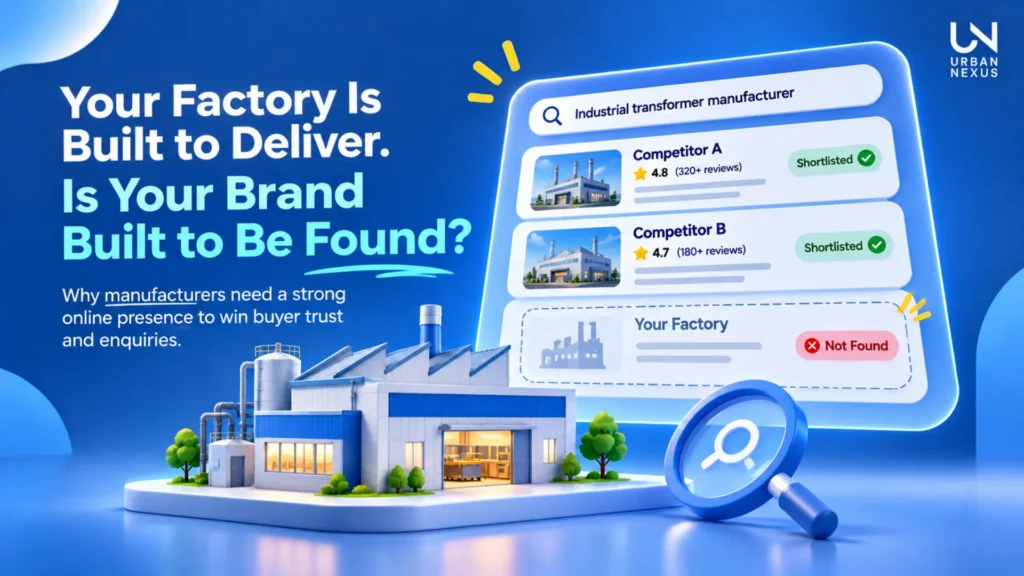
Your factory has been running for decades. Your clients have stayed for just as long. So why did a buyer you have never met just shortlist three of your competitors without calling you?
Because they looked your business up first. And what they found, or didn’t find, decided the rest.
For manufacturers, an online presence is no longer an add-on to exhibitions and references. It is where buyers meet your brand before your sales team gets the chance. So let’s talk about why that first meeting matters, what a strong online presence for manufacturing companies looks like, and where your business can start.
Table of Contents
- Your first meeting now happens without you
- What is an online presence for manufacturing companies?
- What a weak online presence costs your business
- What a strong online presence looks like for a manufacturer
- Common mistakes manufacturers make online
- Where to start: a simple 90-day plan
- Make your business easy to find, and easy to trust
Your first meeting now happens without you
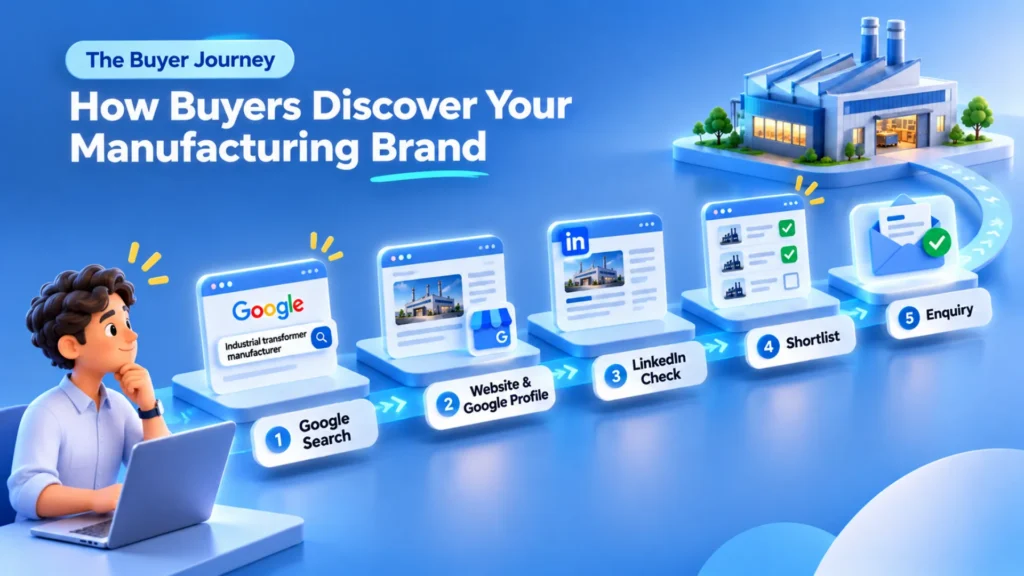
Think about how your own team buys something expensive. Someone searches, reads, compares and asks around before a supplier is ever called.
Your buyers do the same. Forrester research, cited in Sales Layer’s 2026 guide for manufacturers, says 74% of B2B buyers research online before speaking with a supplier. Gartner’s figure, quoted by Move B2B, puts around 80% of B2B sales interactions in digital channels.
In manufacturing, it gets busier. One purchase can involve an engineer checking specifications, a procurement head comparing rates, an operations manager asking about delivery, and an owner thinking about risk. Each of them searches differently. Each of them is asking the same thing: is this company credible?
If your website is thin, your Google listing is outdated and your LinkedIn page has been quiet for two years, the buyer’s answer is no. Your sales team never hears about it, because the call never comes.
Move B2B also points out that deals involving six or more buyers have nearly tripled in recent years, and that an industrial purchase can take months, sometimes over a year. Your online presence has to keep earning trust for that whole stretch.
What is an online presence for manufacturing companies?
An online presence for manufacturing companies is everything a buyer can find about your business without calling you. It includes your website, Google Business Profile, search rankings, LinkedIn page, certifications, case studies and customer reviews. Together, they help buyers verify your credibility and shortlist your business before the first conversation.
It is not a brochure. It is a sales conversation that runs all day, in every city, whether your team is in the office or not.
What a weak online presence costs your business
- Missed shortlists. Buyers rule suppliers out long before they ask for a quote, and you never see it happen.
- Weaker pricing power. When a competitor explains their capability better, your price gets compared without your story.
- Limited reach. A buyer in another state or country can compare suppliers within minutes. If your business is not findable, it is not considered.
- Heavy dependence on exhibitions and referrals. Both still matter, but both are limited by who you can meet and who remembers you.
- No place in AI answers. Buyers now ask tools like ChatGPT, Gemini and Perplexity to suggest suppliers. These tools tend to pick brands with clear, consistent, well-structured content.
What a strong online presence looks like for a manufacturer
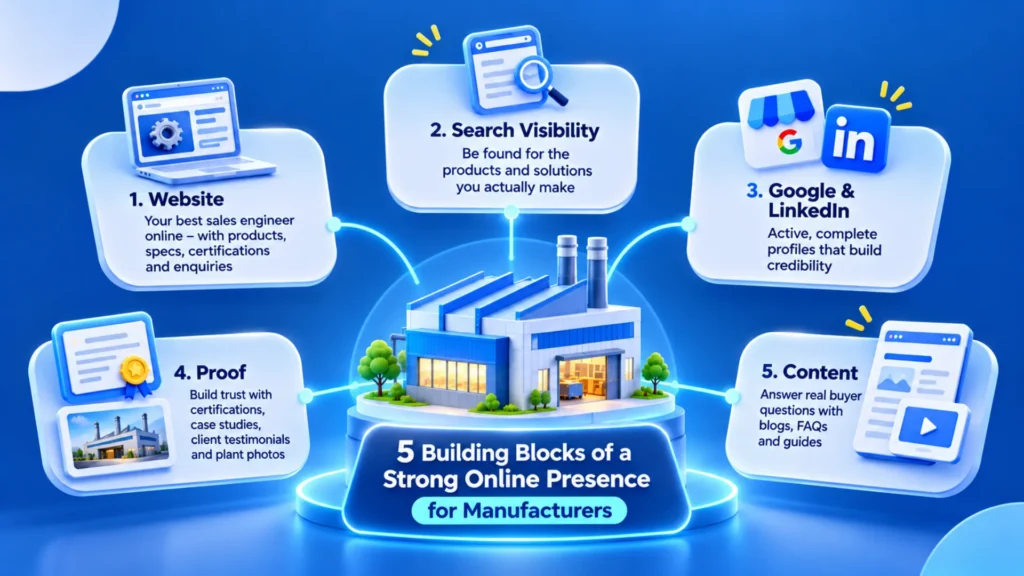
Your business doesn’t need all five of these on day one. But they work best together.
1. A website that works like your best sales engineer
Most manufacturer websites read like a brochure. Buyers want product pages with specifications, applications, certifications, downloadable catalogues and an easy way to request a quote. Make it work well on mobile too, because many technical buyers check details on the shop floor or at a client site.
2. Search visibility for what you actually make
Buyers search for a product, a material, a standard, a process or a city. SEO makes sure your pages answer those searches. Group products by application (“enclosures for outdoor electrical panels” works better than “our products”) and use the words buyers use, not only the words used inside your plant.
3. A Google profile and LinkedIn page that look alive
A complete Google Business Profile with photos, products, reviews and correct details helps regional buyers find you. LinkedIn is where decision-makers check your credibility. Share factory capabilities, certifications, project highlights and your team’s expertise, not just festival greetings.
4. Proof, shown openly
Technical buyers trust evidence. Case studies, client testimonials, quality certifications, plant photos and short process videos do more work than any tagline. Put them where buyers will see them, not in a folder on someone’s laptop.
5. Content that answers real questions
Which material suits this application? How does your product compare with the alternative? What does delivery look like? Blogs, FAQs and guides that answer these questions build trust early. They also make your business easier for AI search tools to understand and quote.
Not every buyer is ready to enquire straight away. Occasional emails with product updates, case studies and new certifications keep your brand in mind while the decision is still being made.
Common mistakes manufacturers make online
- Treating the website as a one-time project and never updating it.
- Posting only festival creatives, with no product or capability content.
- Running ads without a proper landing page.
- Not tracking where enquiries come from, so nobody knows what is working.
- Inconsistent messaging, such as sales teams using old brochures that say something different from the website. Buyers notice.
- Expecting results in a month. Paid campaigns can show early signals within weeks, while SEO and content build over several months.
Where to start: a simple 90-day plan
At Urban Nexus, we work in 90-day cycles: audit, execute, then analyse. For a manufacturer, that looks like this:
- Days 1 to 30, audit and plan. Review your website, Google profile and LinkedIn page, and see how competitors show up. List the products and buyer questions that matter most.
- Days 31 to 60, fix and publish. Update key product pages, complete your Google profile, publish your first articles and case studies, and set up enquiry tracking.
- Days 61 to 90, measure and refine. See which pages, searches and posts bring qualified enquiries, and do more of that.
Then the cycle repeats, so growth builds on itself instead of restarting every quarter.
Add one measurable goal for the quarter, such as cutting response time to qualified technical enquiries from 72 hours to 24 (an example from Sales Layer’s guide). A slow reply can undo good visibility.
The goal is simple: make your digital presence match the scale and legacy your business has built over the years. That is the right goal for any manufacturer with a strong offline reputation.
Make your business easy to find, and easy to trust
Manufacturing buyers do their homework before they call. A clear website, findable products, visible proof and steady content give your business a place on the shortlist, and a reason to be called.
If your brand is strong offline but quiet online, that is the first thing to fix. Book a strategy call with Urban Nexus, and let’s turn your factory’s reputation into enquiries.
Frequently Asked Questions
Why does a manufacturing company need an online presence?
Buyers research suppliers online before contacting anyone. A clear website, a complete Google profile and visible proof help your business get shortlisted, build trust with engineers and procurement teams, and receive enquiries from cities and countries your sales team may never reach through exhibitions and referrals alone.
What should a manufacturing website include?
Detailed product and capability pages, specifications, applications, certifications, case studies, downloadable catalogues, plant photos and a clear enquiry form. It should load fast and read well on mobile, because many technical buyers check details on the shop floor or at a client site.
Is SEO or paid advertising better for manufacturers?
Both have a role. Paid ads can show early signals within weeks, which suits new products or markets. SEO and content take several months but keep bringing enquiries without per-click costs. Most manufacturers do well starting with SEO foundations, then adding paid campaigns for priority products.
Can a small manufacturer compete online with bigger brands?
Yes. Buyers search for specific products, applications and locations, so a focused business with clear pages, strong proof and regular content can show up for the searches that matter. Depth in your niche is what buyers and search engines reward, more than size.
How does AI search affect manufacturers?
Buyers increasingly ask AI tools like ChatGPT or Gemini to suggest suppliers. These tools favour clear, consistent, well-structured content. Detailed product pages, FAQs, case studies and identical business details across Google, LinkedIn and your website improve your chances of being mentioned.
How long does it take to see results from digital marketing for manufacturing?
It depends on the channel. Paid campaigns can show early signals within weeks, while SEO and content typically build over several months. Because industrial sales cycles are long, track enquiry quality and engagement along the way, not only closed deals.